
Specialized Glass Packaging Crates for Zero-Breakage Logistics
Transport architectural and automotive glass safely with engineered A-Frames, L-Frames, and End-Caps designed to eliminate flex, vibration, and surface scratches during transit.
The High Stakes of Transporting Glass
Glass logistics is unforgiving. A single crack renders the entire sheet worthless, and improper packing endangers your handlers. Relying on standard shipping crates without vertical support guarantees breakage from road vibration.
Flex & Shatter
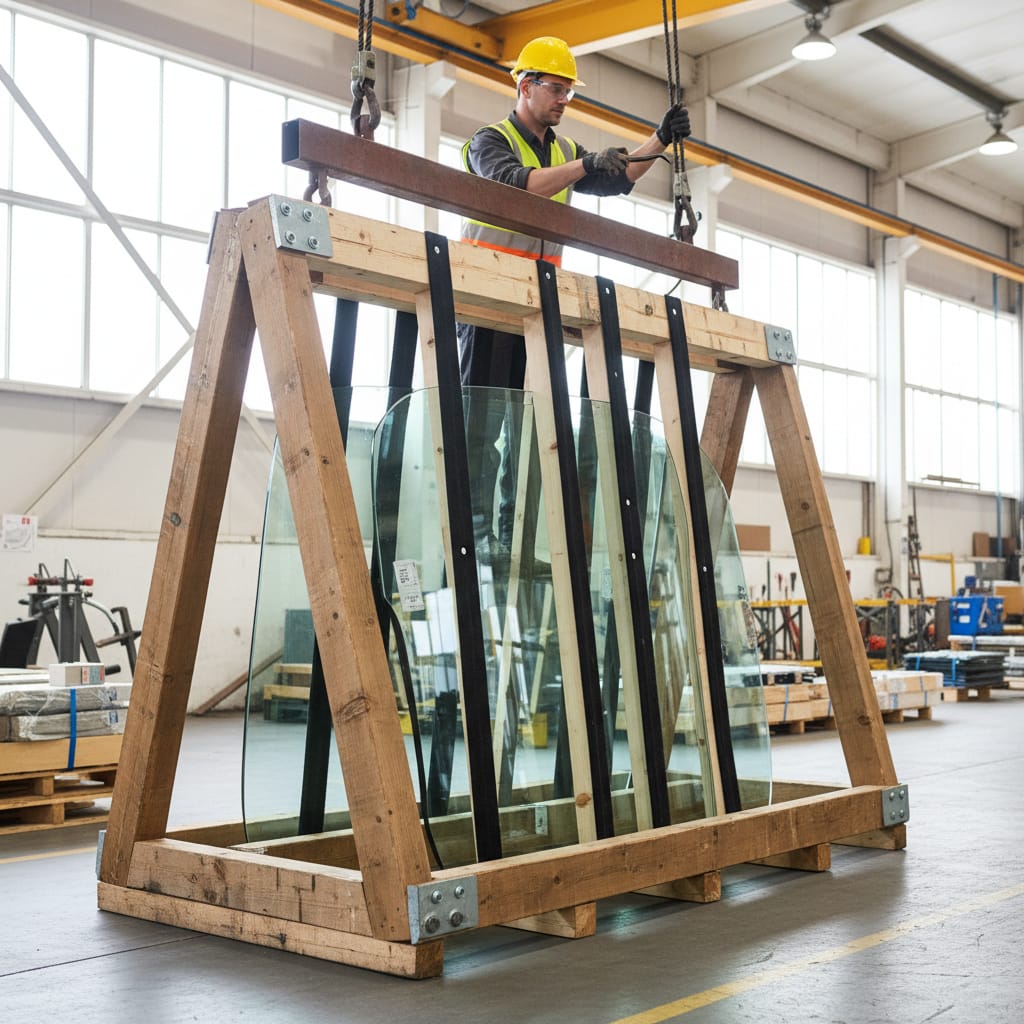
transporting glass flat causes it to flex and shatter under its own weight. You must use vertical custom-built A-Frames to maintain structural rigidity against the G-forces of transport.
Surface Damage
Without proper separation, glass sheets fuse together or scratch due to friction. We utilize interleaving materials that standard heavy-duty crates often ignore, preserving the optical clarity of your product.
Handling Hazards
Unloading heavy glass is dangerous. Poorly designed crates without proper lifting points put your team at risk. Our designs prioritize safety, functioning as reliable reusable handling assets.
Engineered Support for Fragile Sheets
We manufacture specialized wooden packaging for the glass industry. Whether you are shipping automotive windshields or architectural glazing, our crates ensure vertical stability and shock isolation.
A-Frame & End-Caps
We design robust glass packaging structures like A-Frames for bulk sheets and End-Caps for economical packing. These designs ensure the load travels in the safest “ride direction” relative to the truck.
Interleaving Protection
To prevent fusion and scratches, we integrate felt liners, rubber pads, and powder interleaving. This attention to surface detail is critical for long-haul overseas shipping where humidity varies.
Solar & Auto Specs
Our expertise extends to solar panels and curved automotive glass. We create stackable module crates that protect delicate edges while maximizing container density.
Crane-Ready Design
All our glass crates feature reinforced lifting points and skids for forklift access. This ensures safe, controlled movement from your factory to the construction site.
Genuine people. The Wooden Boxes were strong and neat. Our shipment went a long distance without any damage. The owner is very polite and helpful.
Manish Aggarwal
General Supply
Very fast service. I called them for an urgent requirement and got the material the next day. The Pallet Crate is strong and well built.
H.S. Grewal
Transportation Equipment
Bought standard GMA Pallets from them. Strong wood quality. We use them roughly at the site and they are still in good condition. Highly recommended.
Dinesh S.
Building Materials
Clean finishing on the Wooden Crates. There were no rough nails or sharp edges coming out, so our product remained safe from scratches. Good service by the team.
Rahul V.
Appliance
These Pallet Boxes are very sturdy. We used them for heavy storage and they held up well even after rough use. Delivery was fast which helped us a lot during the busy season.
Gurdeep C.
Agricultural
Good quality Block Pallets. We stack them high in the warehouse and they are very stable. Pricing is also better than the market rates. Reliable supplier for bulk orders.
Praveen L.
Warehouse & Storage
Clear the Path for Safe Delivery
Step 1: Dimension Check: We measure your glass dimensions, thickness, and curvature.
Step 2: Structural Design: We engineer the A-Frame or End-Cap to support the specific weight load.
Step 3: Safe Dispatch: We deliver the crates ready for loading, with all protective liners installed.
View A-Frame Specs
Stop fearing the sound of broken glass.
We guarantee stability; our designs are calculated to prevent tipping and flexing under normal transport conditions.
What are the benefits of A-Frame crates for glass?
A-Frame crates are the industry standard for transporting glass because they keep sheets in a near-vertical position, usually leaned back at a slight angle (around 5-10 degrees). This orientation directs the weight of the glass into the robust base of the crate rather than relying on the glass’s weak tensile strength to support itself flat. Transporting glass flat causes it to flex and bounce with road vibrations, leading to shattering. The A-Frame structure provides rigid support along the entire back of the stack, preventing flexion. It also allows for efficient high-density loading of multiple sheets. For automotive windshields or architectural glazing, A-Frames offer the safest “ride” dynamics, ensuring your glass arrives intact and ready for installation.
How do you prevent scratches on glass surfaces?
We prevent scratches by strictly enforcing separation between glass surfaces. Glass-on-glass contact, combined with transit vibration, leads to friction damage and fusion. We utilize specialized interleaving materials such as acid-free paper, cork pads with adhesive backing, or powder separators between every single sheet. For high-value optical or automotive glass, we line the contact points of the wooden crate with soft felt or rubber foam to prevent abrasion from the packaging itself. This attention to surface detail ensures that the optical clarity of your product is preserved. We understand that a scratched windshield is a rejected windshield, so our packaging is designed to protect the finish as rigorously as it protects the structure.
Is it better to transport glass vertically or flat?
It is almost always better to transport glass vertically. Glass is extremely strong under compression (on its edge) but relatively weak under tension (when flexing flat). Transporting glass flat acts like a trampoline; every bump in the road causes the center of the sheet to oscillate, creating immense stress that leads to cracks. Vertical transport eliminates this flex. Our crates are designed to hold glass upright, securely braced against a structural backboard. Even for curved automotive glass, we design nested vertical stacks. The only exception might be small, thick blocks, but for any sheet material, vertical orientation in an engineered crate is the only way to guarantee survival against the G-forces of logistics.
How do you handle large architectural glass sheets?
Handling oversized architectural glass requires specialized heavy-duty crating and handling protocols. We design “jumbo” size crates with reinforced longitudinal skids that resist bending during crane lifts. These crates often feature an open-top or side-loading design to allow vacuum lifters or overhead cranes to access the glass safely at the construction site. We calculate the tipping forces to ensure the crate has a wide enough base to remain stable during transport and wind loading. Safety is paramount; we mark center-of-gravity and lifting points clearly to protect the rigging crews. Our experience with oversized loads ensures that even the largest facade panels can be transported from the factory to the skyscraper without incident.
Can you ship curved automotive glass safely?
Yes, shipping curved automotive glass (like windshields and rear windows) is a core competency. We design crates with internal dunnage that matches the specific curvature of the glass. We use die-cut foam or wooden contours lined with rubber to cradle the edges of the glass, ensuring that the load is supported at its strongest points and not on the delicate center of the curve. We typically nest these parts to maximize container density while ensuring a gap is maintained between each unit using spacers. This nesting approach prevents the “domino effect” of breakage. Whether for OEM supply to factories like Maruti or aftermarket export, our curved glass packaging minimizes vibration and ensures high-volume safe delivery.

